
Register now for CSICon Las Vegas, October 27-30, 2016.
Registration ClosedLife as We Know It: An Interview with Jill Tarter
by Leonard Tramiel
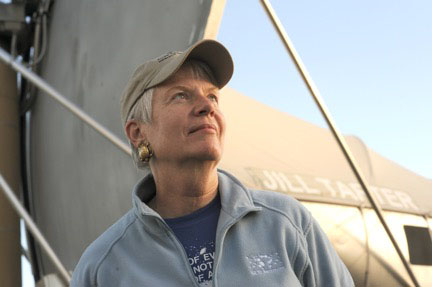
CFI Board Member Leonard Tramiel recently interviewed SETI’s Jill Tarter. Many are familiar with Tarter’s work as portrayed by Jodie Foster in the movie Contact.
Leonard Tramiel: SETI is a topic of great general interest and the primary focus of your career. Are there any new developments in the SETI field in general and anything that would be of particular interest to the skeptical community?
Jill Tarter: Exoplanets and extremophiles have been the game changers during my career. I think skeptics would be particularly interested to understand that these pieces of the puzzle that we can validate have gone in the direction of making the universe at least appear more bio-friendly.
Life, as we know it, is a planetary phenomenon: life has evolved on this planet, it has been profoundly impacted by the planet, and in return, it has profoundly impacted the planet. (The same may be said for planetary moons, but we have no evidence yet). When I started out in this game we knew of nine planets—period. Because the SETI group at Ames (John Billingham’s Interstellar Communication Committee) and the participants of the 1971 Cyclops summer study wanted to know if other stars actually had planets, they began holding splinter workshops on the topic. Bill Borucki was one of the attendees. When SETI started getting golden fleeced, and having its funding attacked, John Billingham wisely asked David Black to take over these studies and move them to the space sciences side of the house to protect them from being tarred and feathered by association. Twenty-five years later, Kepler launched, and together with ground-based radial velocity studies has shown us there are more planets than stars in the Milky Way.
As a student, I learned that all life was powered by the Sun—that life could not exist where it was too hot or too cold, where pressures were much different from 1 bar, where the pH was far from neutral, or in intense radiation fields. Well we’re finally moving away from our equating life with human life and humans as being the pinnacle of evolution, and all these constraints have been demolished by extremophiles. They are, of course, only extreme from our point of view; they are well adapted and cozy in their own niches. For life as we know it, liquid water seems to be the limiting resource—everywhere we’ve looked, life is abundant, with perhaps parts of the Atacama Desert being the exception (or maybe our instruments are lacking in sensitivity). As for life as we don’t yet know it, our instruments are not designed to find that. So the sorts of “weird life” considered by the NAS in their 2007 report “The Limits of Organic Life in Planetary Systems” could in fact exist on Earth today or on distant real estate orbiting other stars. Now that we know that real estate is there, extremophiles suggest we should investigate worlds unlike Earth as well as looking for Earth 2.0.

Tramiel: In keeping with the skeptical theme of CSICon, what are some common misconceptions about SETI?
Tarter:
- That SETI and UFOs are related or the same thing. SETI uses the tools of the astronomer to attempt to find evidence of somebody else’s technology coming from a great distance. If we ever claim detection of a signal, we will provide evidence and data that can be independently confirmed. UFOs—none of the above.
- That SETI is funded by the U.S. Government (or other federal authorities in other countries). This has not been true since 1993. SETI began as a NASA project within the life sciences division of the agency. Later it was moved to the space sciences division. In 1993 Senator Bryan (D-NV) introduced an amendment to NASA’s FY94 budget to terminate all funding for SETI, and he did so with vengeance, letting NASA know that its overall budget would suffer if NASA were to re-introduce SETI funding in future years. Since 1993, our searches at the SETI Institute have been privately funded through philanthropy. The Berkeley SETI Research Center (BSRC) has received some funding over the years from the National Science Foundation and NASA as part of its equipment development for CASPER.
- We just got $100M from Yuri Milner. Not true. Yuri Milner made a pledge of $100M in July of 2015 to support ten years of SETI research, but none of that has come to the SETI Institute. Mr. Milner has written contracts with the Green Bank Telescope in West Virginia and the Parkes Telescope in NSW Australia to rent time on those facilities for SETI observations; he has also contracted with BSRC to build instrumentation for those facilities and conduct SETI observations.
- That any signal detection will immediately be covered up by the U.S. military. Not true. SETI is just one of the many topics for conspiracy theorists. In fact, all the SETI research groups I know of have experienced false positive detections, and prior to the group being able to conduct full verification, the information has leaked to the public and become widespread without any apparent interest from any government.
Tramiel: Do a lot of people ask you about UFOs? How do you respond?
Tarter: Sigh.... Unfortunately, the answer is yes. In response I point out that I am sure that there is physics that we don’t yet understand, and that I wouldn’t be surprised if people had actually seen manifestations of such (sprites and elves—lightning traveling upwards from the top of a thunderstorm anvil cloud was a case in point in the twentieth century—and yes, scientists do themselves no favors by adopting such fanciful names). What is lacking is any credible evidence or data tying visual sightings with extraterrestrial spacecraft. None, zero, zip.
Tramiel: You have been a champion for increasing science literacy and skepticism for some time. What do you suggest CSI do to help increase the spread of our message?
Tarter: Get to the kids! Classes in skeptical thinking are just as important as sex ed in middle/high school. Use the web more. Randi, Penn and Teller, and even Keith Barry are a good start, but the audiences are relatively small and already adult. You need to become part of the atmosphere that the kids are absorbing via their devices—including games and apps. no clue about entry portal here; would suggest Reading Rainbow’s LeVar Burton or SimCity’s Will Wright. Carl Sagan had a good track record, but Bill Nye and Neil deGrasse Tyson have not been able to deliver.